Romans, Galatians by Gerald Borchert & Roger Mohrlang
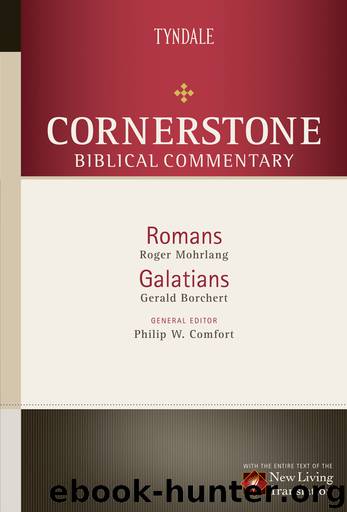
Author:Gerald Borchert & Roger Mohrlang
Language: eng
Format: epub
Tags: RELIGION / Biblical Commentary / New Testament
Publisher: Tyndale House Publishers, Inc.
Published: 2007-03-29T04:00:00+00:00
COMMENTARY [Text]
Does the failure of the Jews to respond to Christ mean that God has rejected his people entirely, written them off in toto? No, Paul replied, God has not rejected his people as a whole because there are clearly some Jews who have come to believe in Christ—Paul himself is a living example. But these are a chosen few, those whom God, in his mercy, claimed for himself from the very beginning of time (11:1-2, 5, 7; cf. Eph 1:4, 11). As it was in the days of Elijah, so it is now: only a small minority can be called the true people of God, because it is only a small minority that God, in his kindness, has chosen to belong to himself (11:2-4). Here Paul returns to his earlier emphasis on God’s sovereignty in choosing who will be his people (see 9:6-29).
The Bible often portrays God’s people, those who truly belong to him, as a small minority of the population, a “faithful remnant.” In passages throughout the Old Testament, the overall impression we get is that only a small minority of the people who considered themselves God’s people remained wholeheartedly faithful to the Lord. The notion of the faithful remnant may be seen in the accounts of Joshua and Caleb, whose trust in God allowed them to enter Canaan when the rest of their generation were excluded (Num 14:30, 36-38); in Elijah’s sense that he was the only faithful servant of the Lord left, in the terrible days of King Ahab (1 Kgs 19:10, 14; cf. 1 Kgs 19:18); in the courageous acts of the two great reformers, Hezekiah and Josiah, when pagan practices were widespread in the land (2 Kgs 18:1-8; 23:1-25); in God’s promises of mercy and deliverance for the small remnant that would survive his judgment on Judah (Isa 10:20-22; Jer 23:3; 31:7; 50:20; Mic 2:12; 4:7; 5:7-8; Zeph 2:7); in the return of a small minority after the Exile, with God’s promise of blessing on them (Ezra 9:8-15; Zech 8:6, 11); and in the apocalyptic stories of Daniel and this three friends in the threatening environment of a foreign country (Dan 1–6). In the New Testament, the idea of the faithful few is expressed in Jesus’ words, “Many are called, but few are chosen” (Matt 22:14); “The highway to hell is broad, and its gate is wide for the many who choose that way. But the gateway to life is very narrow and the road is difficult, and only a few ever find it” (Matt 7:13-14); and in his response to the question, “Lord, will only a few be saved?” (Luke 13:23). This emphasis on the faithful few is also found in several of the New Testament letters and the book of Revelation. So in the Bible, generally, God’s true people are often viewed as only a small minority who remain faithful. This emphasis challenges all claims that the Bible teaches a form of universal salvation, as well as the common assumption that the
Download
This site does not store any files on its server. We only index and link to content provided by other sites. Please contact the content providers to delete copyright contents if any and email us, we'll remove relevant links or contents immediately.
The Five People You Meet in Heaven by Mitch Albom(3550)
The Secret Power of Speaking God's Word by Joyce Meyer(3165)
Real Sex by Lauren F. Winner(3006)
Name Book, The: Over 10,000 Names--Their Meanings, Origins, and Spiritual Significance by Astoria Dorothy(2975)
The Holy Spirit by Billy Graham(2942)
0041152001443424520 .pdf by Unknown(2843)
How The Mind Works by Steven Pinker(2811)
ESV Study Bible by Crossway(2773)
Ancient Worlds by Michael Scott(2680)
Churchill by Paul Johnson(2577)
The Meaning of the Library by unknow(2563)
The ESV Study Bible by Crossway Bibles(2547)
The Gnostic Gospels by Pagels Elaine(2522)
MOSES THE EGYPTIAN by Jan Assmann(2411)
Jesus by Paul Johnson(2351)
City of Stairs by Robert Jackson Bennett(2339)
The Complete Dead Sea Scrolls in English (7th Edition) (Penguin Classics) by Geza Vermes(2269)
The Nativity by Geza Vermes(2226)
Ancient Near Eastern Thought and the Old Testament by John H. Walton(2220)
